

The Government of Aragon will offer scientific and tourism outreach activities and screenings at the official eclipse observation points
The regional government reminds that registrations, which amount to 4,539 registered individuals, must be made through the official Turismo de Aragón website, and urges people to reduce travel on that day.
“The best way to enjoy it is to plan the day in advance, avoid unnecessary travel and consult only the official channels,” said Miguel Ángel Clavero.
The Government of Aragon has strengthened its preventive information campaign ahead of the total solar eclipse on 12 August with new materials aimed at residents and visitors travelling to the region to observe the phenomenon. The Department of Finance, the Interior and Public Administration has placed safety, planning and clear information at the core of this new preparedness phase, as announced on Friday by Miguel Ángel Clavero, Director General of the Interior and Emergencies.
The Government of Aragon does not approach the eclipse as a tourism event or a celebration, but as an exceptional phenomenon that may generate high levels of mobility within a very short period of time. The Director General of the Interior and Emergencies has therefore stressed that “the best way to enjoy it is to plan the day in advance, avoid unnecessary travel whenever possible and consult only the official channels.”
At this stage, the preventive message focuses on three key ideas: planning, official information and self-protection. Anyone wishing to see the eclipse should decide in advance where they will be, how they will travel, how long they will stay and what conditions they may encounter. The phenomenon will also take place at the height of August, with high temperatures, a risk of forest fires and heavy traffic across the region.
The Directorate General of the Interior and Emergencies has released new leaflets with practical recommendations on road safety, travel, forest fire prevention, heat protection, respect for the natural environment and safe eclipse observation using certified glasses and appropriate filters. The materials have been published in Spanish, English, French and German to ensure international visitors are also informed.
This latest action builds on the work carried out in recent months. Before the end of the school year, 102,000 pairs of certified eclipse glasses were distributed to schools across Aragon, accompanied by a leaflet with recommendations for pupils. A further 60,000 pairs of glasses and informational leaflets were also distributed through the tourism office network.
Growing registrations
Alongside the information campaign, four Official Government of Aragon Observation Points (POGA) have been set up in Épila, Calamocha, MotorLand Aragón and Javalambre to channel part of the expected influx towards prepared sites.
The four POGA have received a combined 1,321 access unit reservations — with a total capacity of 15,000 vehicles — corresponding to 4,539 registered individuals. The figures reflect a positive trend in registrations and confirm that a proportion of visitors are choosing to organise their travel through prepared sites.
The pace of bookings has intensified as the eclipse date approaches: more than half of those registered signed up during July, and the week of 13–19 July was the busiest so far, with 916 individuals registered.
The Government of Aragon expects registrations to continue rising in the coming weeks as the information campaign intensifies and more people finalise their plans for 12 August. The Directorate General of the Interior and Emergencies therefore urges the public to book in advance, avoid unplanned travel and always consult official information.
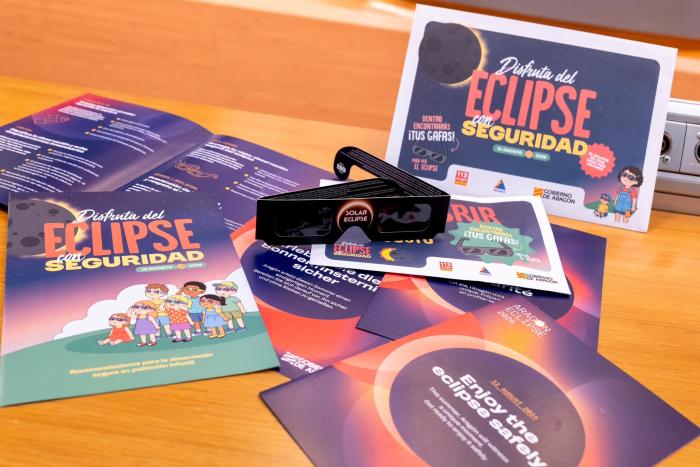
Leaflets with tips and glasses to enjoy the eclipse safely. Fabián Simón
English
By observation point, Javalambre currently has the highest number of registered individuals, with 1,886 people and 548 reservations. It is followed by Calamocha, with 1,008 people and 296 reservations; Épila, with 992 people and 282 reservations; and MotorLand Aragón, with 653 people and 195 reservations. Javalambre accounts for just over 40% of all registered individuals, while Calamocha and Épila show very similar figures.
In practice, the 1,321 reservations also correspond to 1,321 vehicles or access units, a particularly relevant figure from the perspective of mobility, parking and the management of entry and exit flows.
Regarding the type of reservation, the majority are for standard vehicles, with 1,026 reservations and 3,613 people — nearly eight out of every ten registered individuals. In addition, there are 136 vehicle-with-camping reservations, accounting for 468 people, and 159 motorhome reservations, with 458 people.
These figures confirm the interest the eclipse is generating both within and beyond Aragon, but they also reinforce the need to stress advance planning and the use of prepared sites. It is not just about people wishing to observe the eclipse, but also about vehicles, access routes, parking, overnight stays and basic services that need to be organised in advance.
At these points, “visitors will have secure parking, a place to stay overnight, restroom and food service areas, drinking water and an outreach programme, as well as a marquee with a screen to watch the eclipse even if weather conditions are not favourable at that location and time,” Clavero explained.
Domestic and international origins
The majority of reservations come from Spain, with 3,873 registered individuals, although 666 people from abroad have also signed up. In total, reservations are linked to more than thirty countries, with a particularly strong presence from France, the United States, Germany, the United Kingdom and Italy.
Within Spain, the main regions of origin are Aragon, with 1,439 people; the Valencian Community, with 882; Catalonia, with 808; and the Community of Madrid, with 314. By province, the most prominent are Zaragoza, Barcelona, Valencia, Madrid, Alicante and Teruel.
The reservation profile points mainly to family trips or small groups. The average is 3.44 people per reservation, and most bookings are for groups of four or five.
“The Official Observation Points are not intended as an attraction or an event in themselves, but as a preventive tool. Their purpose is to manage the arrival of visitors, provide parking and overnight facilities, concentrate basic services and reduce pressure on locations that are not prepared to host large gatherings,” Clavero stressed.
Reservations remain open and must be made exclusively through the official Turismo de Aragón website, where official bookings for the eclipse POGA can be completed.
Local observation points
Municipalities across the region may set up their own local observation point following the instructions provided by the Directorate General of the Interior.
These areas must be chosen based on safety criteria: good eclipse visibility, low fire risk, adequate access, organised parking and the possibility of rapid evacuation.
Vehicle access may not use tracks or paths that cross forested areas, so safe routes free of sensitive vegetation must be used. From the car park to the observation point, the route must be signposted and completed on foot.
Municipalities will need to have an evacuation procedure in place, ensure the point is close to a town centre and basic services, and report its location and characteristics to the Directorate General of the Interior and Emergencies for coordination purposes.
Information reinforcement in August
In the coming weeks, the Government of Aragon will continue to strengthen preventive information. “From August onwards, the dissemination of advice will be intensified through the media, social networks and institutional channels, with specific messages on heat, forest fires, food, hydration, eye protection and respect for the natural environment, as well as safety during travel and stays and preparedness for emergency situations such as fires or storms, which can be serious given the time of year,” the Director General explained.
“The Government of Aragon asks everyone interested in observing the eclipse not to improvise, to consult official information, to book in advance if they plan to travel to one of the designated points, and to follow Civil Protection recommendations at all times,” affirmed the Director General of the Interior, who recalled that the main objective “is for the eclipse to be enjoyed safely, in an orderly manner and responsibly.”
The official observation points set up by the Government of Aragon for the total eclipse will incorporate LightSound devices that will enable people with visual disabilities to experience this astronomical phenomenon through sound. The Government of Aragon applied to participate in the Inclusive Eclipse project and has obtained the four LightSound devices required for its official observation points. The initiative, led by the Institute of Space Sciences (ICE-CSIC), seeks to make the eclipse experience accessible to people with visual disabilities through technology that converts light into sound.
Share


